
Summary
Self-employed individuals generally report all business income and eligible expenses on their personal income tax return.
Reasonable expenses incurred to earn business income may be deductible, but proper receipts and records should be maintained.
GST/HST registration is generally required once taxable supplies exceed the $30,000 small-supplier threshold, although the timing rules should be reviewed carefully.
Self-employed taxpayers generally have until June 15 to file, but any personal tax balance owing is generally due by April 30.
Self-Employment Comes With Additional Tax Responsibilities
Working for yourself can offer greater flexibility, but it also means taking responsibility for your own tax reporting.
If you are a freelancer, consultant, contractor, sole proprietor, gig worker, or small business owner, there may be no employer deducting income tax from your payments. You may need to calculate your income, track expenses, save for taxes, pay Canada Pension Plan contributions, and determine whether GST/HST registration is required.
Understanding the basics early can help you avoid surprises at tax time.
Are You Self-Employed?
You may be self-employed if you operate your own business, provide services independently, or earn income outside a traditional employment relationship.
Common examples include:
- Freelancers
- Independent contractors
- Consultants
- Tradespeople working for themselves
- Real estate agents
- Online sellers
- Content creators
- Ride-sharing and delivery drivers
- Professionals operating a sole proprietorship
CRA notes that business income includes income earned from a profession, trade, manufacture, undertaking, or another activity carried on for profit. It does not include wages or salary received from an employer.
Simply being called an “independent contractor” does not always determine your tax status. The actual working relationship between you and the payer matters.
Report All Your Business Income
Self-employed individuals must generally report all income earned from their business activities.
This may include:
- Cash payments
- Cheques and electronic transfers
- Credit card payments
- Online platform payments
- Consulting or professional fees
- Commissions
- Sales revenue
- Tips
- Certain barter transactions
CRA confirms that self-employment income from gig work, freelancing, social media platforms, online marketplaces, and other business activities must be reported. Gifts, tips, and donations received through online platforms may also be taxable where they relate to the business activity.
Income may still be taxable even if you did not receive a tax slip.
Gross Income vs. Net Business Income
It is important to understand the difference between gross and net business income.
Gross business income is the revenue earned before deducting expenses.
Net business income is the amount remaining after eligible business expenses are deducted.
For example:
- Gross business income: $80,000
- Eligible business expenses: $20,000
- Net business income: $60,000
The net amount is generally included in your taxable income, subject to the applicable tax rules and adjustments.
What Business Expenses Can You Deduct?
Self-employed individuals may generally deduct reasonable expenses incurred to earn business income.
Common expenses may include:
- Advertising and marketing
- Accounting and legal fees
- Business insurance
- Office supplies
- Software and subscriptions
- Telephone and internet costs
- Bank and payment-processing fees
- Business travel
- Meals and entertainment, subject to limitations
- Motor vehicle expenses
- Business-use-of-home expenses
- Wages paid to employees
- Capital cost allowance on eligible equipment
An expense is not deductible simply because it was paid through a business account. The expense must have a business purpose and meet the relevant tax rules.
Personal expenses are generally not deductible. If an expense has both personal and business use, only the reasonable business portion should generally be claimed.
Keep Proper Business Records
Good records make tax filing easier and help support your claims if CRA reviews your return.
You should keep records such as:
- Sales invoices
- Payment summaries
- Bank and credit card statements
- Expense receipts
- Contracts
- Vehicle mileage logs
- Home-office calculations
- GST/HST records
- Records of equipment and other capital assets
It is also helpful to maintain a separate business bank account and credit card. Although this does not change the tax treatment by itself, it can make personal and business transactions easier to distinguish.
How Is Self-Employment Income Reported?
Most sole proprietors report business or professional income as part of their personal T1 Income Tax and Benefit Return.
If you incorporate your business, the corporation is a separate taxpayer and generally files its own T2 corporate income tax return. CRA specifically notes that its small-business and self-employed income guidance applies to sole proprietors, partnerships, and self-employed individuals, rather than incorporated businesses.
This distinction is important because incorporating changes the legal, accounting, and tax filing requirements.
Know Your Filing and Payment Deadlines
Self-employed individuals generally have until June 15 to file their personal income tax return. The extended deadline may also apply where the taxpayer’s spouse or common-law partner is self-employed.
However, any personal income tax balance owing is generally due by April 30. This means interest may apply after April 30 even though the return itself is not due until June 15.
It is therefore helpful to estimate your tax balance before April 30, even if the final return will be filed later.
Plan for Income Tax and CPP Contributions
Employees usually have income tax and Canada Pension Plan contributions withheld from each paycheque. Self-employed individuals generally do not.
A self-employed taxpayer may need to pay:
- Federal income tax
- Provincial or territorial income tax
- Both the employee and employer portions of Canada Pension Plan contributions
- Tax instalments, where required
- GST/HST collected from customers, where registered
CRA confirms that self-employed individuals may have personal income tax and Canada Pension Plan obligations. Employment Insurance premiums may also apply where a self-employed person is eligible and has voluntarily registered to participate in the applicable program.
Setting aside part of each payment for taxes can help prevent a large unexpected balance.
Do You Need to Register for GST/HST?
GST/HST registration is separate from income tax.
CRA states that a person generally needs to register for GST/HST if taxable supplies exceed $30,000 in a single calendar quarter or over four consecutive calendar quarters.
Taxable supplies generally include revenue from goods and services that are subject to GST/HST, including zero-rated supplies. Certain exempt supplies are treated differently.
Once registered, you may need to:
- Charge GST/HST on taxable supplies
- Provide proper invoices
- Track GST/HST collected
- Claim eligible input tax credits
- File GST/HST returns
- Remit the net amount owing
The timing of registration can be important. A business approaching the threshold should review its revenue regularly rather than waiting until year-end.
You May Need to Pay Tax Instalments
Self-employed individuals sometimes need to make instalment payments because tax is not withheld from their business income.
CRA may send an instalment reminder based on prior-year tax balances. The common instalment dates for individuals are:
- March 15
- June 15
- September 15
- December 15
The amount you should pay may depend on CRA’s suggested amounts, your prior-year results, and your expected current-year tax liability.
Ignoring an instalment reminder can result in instalment interest if insufficient amounts are paid.
Home-Office and Vehicle Expenses Need Careful Records
Home-office and vehicle expenses are common areas of confusion.
For home-office expenses, the deductible portion may depend on factors such as:
- The portion of the home used for business
- The time the space is used for business
- Whether the space is the principal place of business
- Whether the space is used regularly to meet clients or customers
- The nature of each household cost
For vehicle expenses, you should generally track:
- Total kilometres driven during the year
- Business kilometres
- The purpose of business trips
- Fuel, insurance, repairs, lease costs, or financing costs
- Vehicle purchase information, where applicable
A calendar estimate prepared at tax time is not as reliable as a mileage log maintained throughout the year.
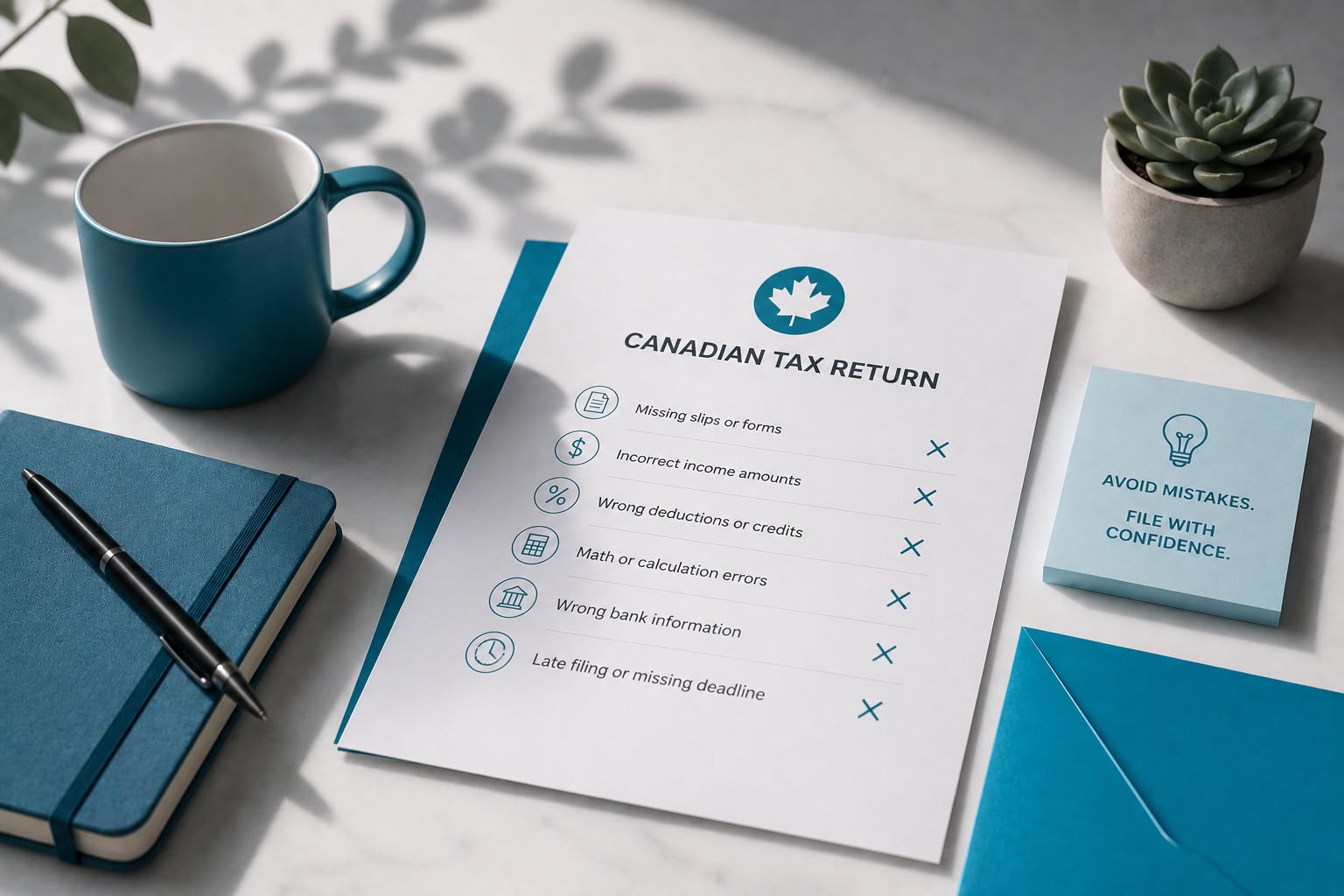
Common Mistakes
Common mistakes made by self-employed taxpayers include:
- Not reporting cash or online income
- Mixing personal and business expenses
- Claiming the full cost of partly personal expenses
- Failing to keep receipts
- Missing the GST/HST registration threshold
- Spending GST/HST collected from customers
- Forgetting about Canada Pension Plan contributions
- Assuming tax is not owing because no tax slip was issued
- Waiting until June to calculate an April tax payment
- Treating a sole proprietorship like a separate legal corporation
- Failing to prepare for tax instalments
These mistakes can result in unexpected tax balances, interest, penalties, or CRA reviews.
When Should You Get Advice?
Consider speaking with a tax advisor if:
- You recently started working for yourself
- You are unsure whether you are an employee or independent contractor
- Your revenue is approaching $30,000
- You have significant home-office or vehicle expenses
- You have income from online platforms
- You work in more than one province or country
- You are considering incorporation
- You received a CRA instalment reminder
- You are behind on tax or GST/HST filings
- Your business income has increased significantly
Getting advice early can help establish good bookkeeping, tax-saving, and compliance habits before problems develop.
Final Thoughts
Self-employed individuals are responsible for more than simply reporting revenue on a tax return. They must track income and expenses, maintain records, plan for income tax and Canada Pension Plan contributions, meet filing and payment deadlines, and monitor GST/HST requirements.
A simple recordkeeping system and regular tax planning can make self-employment much easier to manage.
Confectus can help self-employed individuals understand their obligations, organize their reporting, claim eligible expenses, and plan for taxes throughout the year.
Canadian tax questions? Get expert guidance.
Whether you’re an individual, self-employed, or a business owner, we provide clear advice to help you make informed tax decisions.

This article is intended for general informational purposes only and does not constitute tax, accounting, legal, financial, or professional advice. The information may not apply to your specific situation, and rules or guidance may change over time. You should consult a qualified professional advisor before making decisions or taking action based on this information.