
Summary
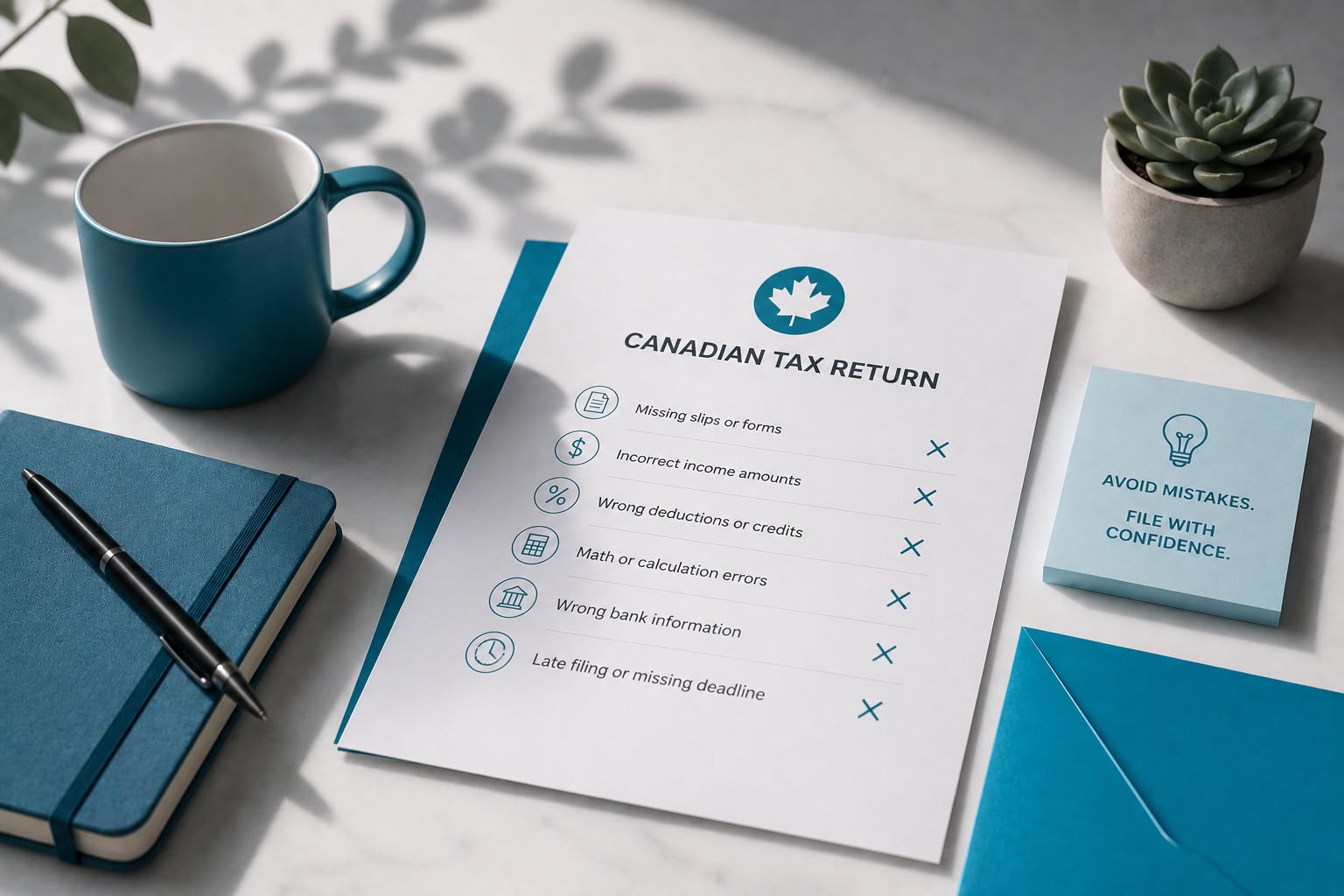
Common tax filing mistakes include missing income, filing late, using incorrect tax slips, and claiming deductions or credits without proper support.
CRA may charge penalties and interest if a taxpayer files late and has a balance owing, repeatedly fails to report income, or makes false statements or omissions.
Filing on time matters even if you cannot pay your full balance, because filing late can create additional penalties.
Good records, early preparation, and reviewing CRA information before filing can help avoid delays, reassessments, and unnecessary stress.
Small Tax Filing Errors Can Create Big Headaches
Tax filing mistakes are common, but some can lead to delayed refunds, CRA reassessments, penalties, interest, or follow-up requests.
Many mistakes are avoidable. The key is to be organized, report all income, keep proper support, and avoid waiting until the last minute.
Below are some of the most common Canadian tax filing mistakes taxpayers should watch for.
1. Missing the Filing Deadline
For most individuals, the personal tax filing deadline is generally April 30. Self-employed individuals generally have until June 15 to file, but any balance owing is still due by April 30.
This is a common source of confusion.
CRA may charge a late-filing penalty if you file after the due date and owe tax. CRA also charges compound daily interest on unpaid tax starting after the payment due date.
If you cannot pay the full balance, it is usually still better to file on time to avoid the late-filing penalty.
2. Forgetting to Report All Income
Another common mistake is leaving out income.
This can include:
- Employment income
- Self-employment or side income
- Tips and gratuities
- Rental income
- Investment income
- Foreign income
- Capital gains
- Pension income
- Government benefit income, where taxable
CRA warns that taxpayers may face penalties if they make false statements, omit information, or repeatedly fail to report income.
Even if you did not receive a tax slip, the income may still need to be reported.
3. Filing Before All Tax Slips Are Available
Filing early can be helpful, but filing too early can create problems if some tax slips are missing.
Common slips include:
- T4 employment slips
- T4A slips
- T5 investment income slips
- T3 trust or mutual fund slips
- RRSP contribution receipts
- Pension slips
- Tuition slips
- Donation receipts
If a slip arrives after you file, you may need to adjust your return. Before filing, it is a good idea to check your records, CRA My Account, and any tax slips available online.
4. Claiming Deductions or Credits Without Support
Deductions and credits can reduce tax, but they need to be claimed properly.
Common examples include:
- Medical expenses
- Charitable donations
- Childcare expenses
- Employment expenses
- Moving expenses
- Business expenses
- Tuition credits
- Interest on eligible student loans
The issue is not just whether a deduction or credit exists. The taxpayer must also meet the conditions and keep supporting documentation.
If CRA reviews the claim, unsupported amounts may be denied.
5. Confusing Deductions and Credits
Deductions and credits are not the same.
A deduction generally reduces taxable income.
A credit generally reduces tax payable.
For example, an RRSP contribution is generally a deduction, while many personal tax credits reduce tax payable. Confusing the two can lead to unrealistic refund expectations or poor planning decisions.
6. Using the Wrong Adjusted Cost Base
For investment sales, capital gains are often calculated using the adjusted cost base.
Errors can happen when taxpayers forget about:
- Reinvested distributions
- Return of capital
- Multiple purchases of the same investment
- Foreign exchange on foreign investments
- Transaction costs
- Prior-year adjustments
Using the wrong adjusted cost base can result in overreporting or underreporting a capital gain.
7. Forgetting About Foreign Income or Foreign Assets
Canadian tax residents generally need to consider worldwide income.
This can include:
- Foreign employment income
- Foreign pension income
- Foreign rental income
- Foreign dividends and interest
- Foreign capital gains
- Income from foreign accounts or investments
Foreign assets may also create separate reporting obligations, such as Form T1135, depending on the facts.
This is especially important for newcomers, returning residents, cross-border taxpayers, and Canadians with investment accounts outside Canada.
8. Not Updating Personal Information
Changes in personal information can affect tax filings, refunds, benefits, and CRA correspondence.
Taxpayers should review changes such as:
- Address
- Marital status
- Direct deposit details
- Dependants
- Name changes
- Residency status
- Authorized representatives
If CRA has outdated information, you may miss notices, benefit adjustments, or important requests.
9. Ignoring CRA Instalment Reminders
Some taxpayers are required to pay tax by instalments. This often applies to individuals who have income without enough tax withheld at source.
Examples may include:
- Self-employed individuals
- Landlords
- Investors
- Retirees
- Individuals with significant taxable investment income
If CRA sends an instalment reminder, do not ignore it. You may need to pay instalments, calculate a different amount, or review whether your current-year income has changed.
10. Mixing Personal and Business Expenses
Self-employed individuals and business owners often run into issues when personal and business expenses are mixed.
Common problem areas include:
- Vehicle expenses
- Meals and entertainment
- Home office expenses
- Phone and internet
- Travel
- Subscriptions
- Equipment
- Shared bank accounts or credit cards
Good bookkeeping makes tax filing easier and helps support claims if CRA asks questions.
11. Forgetting to Review the Notice of Assessment
After filing, CRA issues a notice of assessment. This document should be reviewed carefully.
It may show:
- Refund or balance owing
- Changes made by CRA
- RRSP deduction limit
- Unused losses or credits
- Instalment information
- Carryforward amounts
Do not assume the return was accepted exactly as filed. The notice of assessment is an important tax record.
12. Waiting Until Tax Season to Get Organized
Many filing mistakes happen because taxpayers wait too long to organize records.
A better approach is to keep a simple tax folder throughout the year for:
- Tax slips
- Receipts
- Investment summaries
- Rental property records
- Business income and expenses
- Donation receipts
- Medical receipts
- CRA letters
- Instalment reminders
Better records usually mean fewer errors, fewer missed deductions, and less stress.
Common Mistakes Checklist
Before filing, ask:
- Did I report all income?
- Did I wait for all expected tax slips?
- Did I include foreign income, if applicable?
- Did I check CRA My Account?
- Did I update my address, marital status, and direct deposit?
- Did I keep support for deductions and credits?
- Did I review investment sales and capital gains?
- Did I consider instalments?
- Did I file on time?
- Did I review my notice of assessment after filing?
When Should You Get Help?
You should consider speaking with a tax advisor if:
- You are self-employed
- You own rental property
- You sold investments, real estate, or cryptocurrency
- You have foreign income or assets
- You received a CRA review letter
- You missed reporting income in a prior year
- You are behind on tax filings
- You have a large balance owing
- You are unsure whether a deduction or credit applies
- Your tax situation changed during the year
Professional advice can help identify issues before they become CRA problems.
Final Thoughts
Most Canadian tax filing mistakes are preventable.
The best approach is to file on time, report all income, keep proper records, review tax slips carefully, and check CRA correspondence after filing.
If you are unsure about your tax return, received a CRA letter, or want help avoiding common filing errors, Confectus can help review your situation and prepare your return properly.
Canadian tax questions? Get expert guidance.
Whether you’re an individual, self-employed, or a business owner, we provide clear advice to help you make informed tax decisions.

This article is provided for general informational purposes only and does not constitute tax, accounting, legal, financial, or other professional advice. No representation or warranty is made regarding the accuracy, completeness, or currency of the information, which may contain errors or omissions and may not apply to your specific circumstances. Laws and administrative guidance may change over time. Readers should consult a qualified professional advisor before relying on or acting upon this information.