
Summary
Canadian snowbirds may become US residents for tax purposes under the substantial presence test, even if they spend fewer than 183 days in the US during the current year.
The test generally counts all US days in the current year, one-third of the prior year’s days, and one-sixth of the second prior year’s days.
Form 8840 may allow an eligible Canadian to claim a closer connection to Canada and remain a US non-resident for tax purposes despite meeting the substantial presence test.
Form 8840 is not available in every situation, particularly where the individual spends 183 days or more in the US during the current year or has taken steps toward obtaining a green card.
Snowbirds Need to Track More Than 183 Days
Many Canadian snowbirds believe they will avoid US tax residency as long as they spend fewer than 183 days in the United States during the year.
That assumption can be wrong.
The US substantial presence test uses a weighted three-year calculation. As a result, regularly spending approximately four months per year in the US may be enough to meet the test, even if the individual never spends 183 days in the US during a single year.
Meeting the test can create US tax filing and reporting concerns. Fortunately, some Canadian snowbirds may qualify for the closer connection exception by filing Form 8840.
What Is the Substantial Presence Test?
The substantial presence test determines whether a person who is not a US citizen may be treated as a US resident for federal income tax purposes based on physical presence.
A person generally meets the test if both of the following conditions apply:
- The person was physically present in the US for at least 31 days during the current year.
- The weighted total of US days over the current year and two preceding years is at least 183 days.
The weighted calculation includes:
- All US days in the current year
- One-third of US days in the immediately preceding year
- One-sixth of US days in the second preceding year
The formula can be expressed as:
Current-year US days
+ 1/3 of prior-year US days
+ 1/6 of second prior-year US days
= Weighted day total
Simple Snowbird Example
Assume a Canadian resident spends the following number of days in the United States:
- Current year: 130 days
- Prior year: 120 days
- Second prior year: 120 days
The substantial presence calculation would be:
130
+ 40, representing 1/3 of 120
+ 20, representing 1/6 of 120
= 190 weighted days
The individual has at least 31 US days in the current year and a three-year weighted total above 183 days. As a result, the individual may meet the substantial presence test even though the individual spent only 130 days in the US during the current year.
Do All Days in the US Count?
Generally, a person is treated as present in the US on any day the person is physically present there at any time during the day. However, certain exceptions can apply.
Examples of days that may not count include:
- Certain days spent commuting regularly to work in the US from a residence in Canada or Mexico
- Certain periods of less than 24 hours while in transit between two places outside the US
- Certain days when a person cannot leave the US because of a medical condition that arose while the person was there
- Days when a person qualifies as an exempt individual under specific visa or status rules
These exceptions are fact-specific. Snowbirds should not exclude travel or medical days without confirming that the applicable conditions are met.
What Is Form 8840?
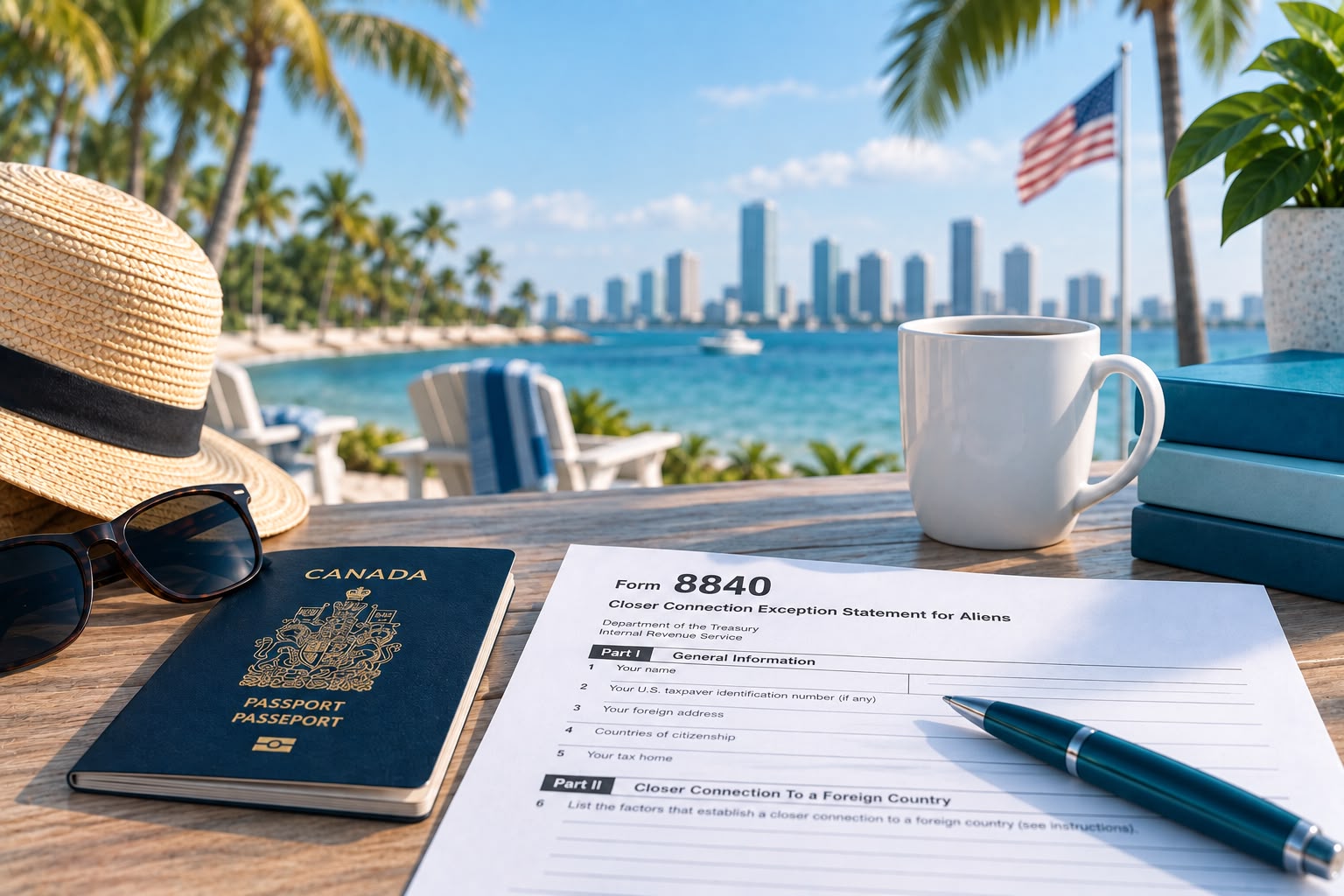
Form 8840, Closer Connection Exception Statement for Aliens, is used to claim the closer connection exception to the substantial presence test.
In practical terms, the form tells the Internal Revenue Service that although the individual met the substantial presence test, the individual maintained a tax home and stronger personal and economic ties outside the United States.
For many Canadian snowbirds, the relevant foreign country is Canada.
Form 8840 requests information such as:
- Citizenship and passport details
- US visa information, where applicable
- Days spent in the US during the current and prior two years
- The location of the individual’s tax home
- The foreign country to which the individual had a closer connection
- Personal, family, financial, business, and social ties
- Whether the individual applied or took steps to apply for US lawful permanent resident status
Who May Qualify for the Closer Connection Exception?
The closer connection exception may be available where an individual:
- Was physically present in the US for fewer than 183 days during the current year
- Maintained a tax home in a foreign country during the entire year
- Had a closer connection to that foreign country than to the US
- Had not applied for, or taken other steps toward obtaining, lawful permanent resident status in the US
These conditions are cumulative. Meeting only one or two is not enough.
The current-year 183-day limit is particularly important. The weighted three-year test and the current-year limit serve different purposes. An individual may meet the weighted substantial presence test while remaining below 183 actual days in the current year. That is the typical situation in which Form 8840 may become relevant.
What Does a Closer Connection to Canada Mean?
The closer connection analysis looks at where the person’s more significant personal and economic contacts are located.
Relevant factors can include:
- Location of a permanent home
- Location of a spouse or common-law partner and family
- Location of personal belongings
- Banking and investment relationships
- Driver’s licence and vehicle registration
- Health coverage
- Social, religious, professional, or community affiliations
- Business activities
- The jurisdiction listed as the person’s residence on official documents
- The tax forms and residency certificates provided to financial institutions or other payers
The IRS considers the person’s overall facts and circumstances when determining whether more significant contacts were maintained with the foreign country than with the United States.
Owning a home in Canada does not automatically establish a closer connection if most of the person’s day-to-day life and economic relationships are located in the US.
Is Form 8840 a US Tax Return?
Form 8840 is an information statement used to claim the closer connection exception. It is not, by itself, a regular US income tax return.
If an individual is otherwise required to file Form 1040-NR, Form 8840 is generally attached to that return. The official Form 8840 states that it should be attached to Form 1040-NR, while individuals filing it on its own provide their Canadian and US addresses directly on the form.
Filing Form 8840 also does not eliminate separate US tax obligations that may arise from US-source income, US rental property, business activities, or other investments.
When Is Form 8840 Filed?
Form 8840 should be filed annually for each year in which the individual meets the substantial presence test and relies on the closer connection exception.
The precise filing deadline and procedure depend on whether the individual is also required to file a US income tax return. If Form 1040-NR is required, Form 8840 is generally attached to that return. If no US return is required, Form 8840 is generally filed separately under the form instructions.
Because filing requirements and addresses can change, snowbirds should review the instructions for the applicable tax year rather than relying on a prior-year form.
What If You Spend 183 Days or More in the US?
The closer connection exception generally cannot be claimed through Form 8840 if an individual is physically present in the US for 183 days or more during the current year.
That does not necessarily end the analysis. Depending on the facts, the Canada-US tax treaty’s residence tie-breaker rules may need to be considered. A treaty-based position can involve additional analysis and US disclosure requirements.
This is no longer a routine snowbird filing situation. Professional cross-border advice should be obtained promptly.
Tax Residency Is Different From Immigration Status
Tax residency and immigration status are related but separate concepts.
A Canadian visitor may comply with US immigration rules and still meet the substantial presence test for tax purposes. Similarly, filing Form 8840 addresses a federal tax-residency issue. It does not extend the period a person is legally permitted to remain in the United States.
Snowbirds should separately monitor:
- US immigration limits
- US federal tax residency
- US state tax residency
- Canadian tax residency
- Provincial health coverage requirements
- Travel and medical insurance limits
A favourable answer under one set of rules does not automatically resolve the others.
Common Snowbird Mistakes
Common mistakes include:
- Assuming the US only looks at current-year days
- Using the immigration limit as the US tax-residency limit
- Failing to count partial travel days
- Not maintaining a reliable travel calendar
- Forgetting short trips, cruises, or same-day visits
- Filing Form 8840 without reviewing whether the eligibility conditions are met
- Assuming Form 8840 eliminates tax on US rental income or other US-source income
- Failing to file Form 8840 for each year it is required
- Spending 183 days or more in the US and assuming Form 8840 remains available
- Ignoring possible US state tax-residency rules
The safest approach is to track US days throughout the year rather than reconstructing travel history at tax time.
Practical Records to Keep
Canadian snowbirds should consider retaining:
- Passport and travel records
- Flight confirmations and boarding passes
- Credit card statements
- Mobile phone location records
- Vehicle entry and exit records
- A daily travel calendar
- Canadian home ownership or lease records
- Canadian tax returns
- Provincial health coverage records
- Canadian driver’s licence and vehicle registration
- Evidence of Canadian banking, professional, family, and community ties
Records should support both the day count and the closer connection to Canada.
When Should You Get Advice?
Consider obtaining cross-border tax advice if:
- Your weighted three-year day count is approaching or exceeds 183 days
- You spent close to 183 actual days in the US during the current year
- You own or rent a home in the US
- You earn US rental, investment, employment, or business income
- You have significant family or economic ties in the US
- You applied for a green card or took steps toward permanent resident status
- You missed filing Form 8840 for a prior year
- You received correspondence from the IRS
- You may be considered resident in a US state
- You are unsure whether excluded days apply
Small differences in travel dates, immigration steps, living arrangements, and personal ties can change the result.
Final Thoughts
Canadian snowbirds should not rely only on the idea that staying below 183 days in the US avoids US tax residency.
The substantial presence test uses a weighted three-year calculation that can apply even when current-year US travel is well below 183 days. Eligible individuals may use Form 8840 to claim a closer connection to Canada, but the exception is subject to specific conditions and must be considered annually.
Confectus can help Canadian snowbirds calculate their US day count, assess the closer connection requirements, review Form 8840 eligibility, and identify other Canadian and US tax issues arising from time spent south of the border.
Canada-U.S. tax situation? Get clarity before you act.
Whether you are moving, investing, filing in two countries, or catching up on past obligations, we can help you understand your next step.

This article is intended for general informational purposes only and does not constitute tax, accounting, legal, financial, or professional advice. The information may not apply to your specific situation, and rules or guidance may change over time. You should consult a qualified professional advisor before making decisions or taking action based on this information.